Liquid Glass has reignited ideas that never quite disappeared
From Apple’s Liquid Glass to Aqua Design: interfaces that behave like states of matter.
- Published
Some friends open doors for you. With them you share more than interests or hobbies: you trade ways of seeing things and guesses about the future. Adriel Zárate, a senior front-end developer and designer, is one of those friends. A conversation with him can turn into a long session imagining what comes next, whether it starts with anime, social criticism, artificial intelligence, or how people might live someday.
That morning, like most mornings, I started the day reading design and technology news. One piece caught my eye: Apple’s announcement of its new design system, Liquid Glass. At first it looked like an aesthetic update of what Material Design proposed years ago, with one twist. Where Material drew on paper and layers, this concept used glass as its central material. The interfaces simulate fluidity, and they also change shape and structure as if they were matter in motion.
I sent the news to Adriel to hear what he thought. He answered right away and, as he often does, surprised me and got me imagining again:
“That idea came to me a while ago… not the same, but definitely about using a liquid.”
That small spark, a new technology meeting an old idea, turned into a longer conversation. It took me past Apple’s liquid glass to a bigger question: what if our interfaces could also evaporate, solidify, and transform again, the way water changes state?
The new announcement in UI design: Liquid Glass
Apple often unveils polished visual concepts. But that day, Liquid Glass felt different. Beyond the finish and the smooth animations, Apple seemed to want to rebuild its visual language around a new material, glass, and put it at the center of the experience.
Material Design, introduced in 2014, was flat and geometric. Liquid Glass goes for fluidity, refraction, reflections, and translucency. Its components look like glass and also behave like liquid glass, changing their form.
It also brings back an idea from the early iPhones: elements that feel almost tangible while staying digital.
That was where the conversation with Adriel started. A design inspired by glass led us somewhere wider: materials changing state, and water in particular, where life began.
Materials that behave like states of matter
What caught me about Adriel’s reply was the pattern more than the content. It has happened before. I share something I see as a big innovation, and he comes back with “I thought of something like that a while ago,” followed by an explanation that widens the original idea or sends us somewhere new. It isn’t arrogance; he’s one of the most humble people I know. In many of our conversations he has anticipated trends, and he tends to look at the present from a few years ahead.
This time was the same. He said:
“Yes, I remember imagining something like that. I thought about water instead of paper when Material Design came about, but not just as a liquid. I was also thinking of water that could change states, able to be in its liquid, solid, and gaseous forms.”
That opened up a lot of possibilities in my head.
What Apple showed was a great visual exploration. Adriel’s idea was more conceptual: an interface that can transform the way water does. A frozen element stands for permanence. It can evaporate to disappear, or flow to adapt.
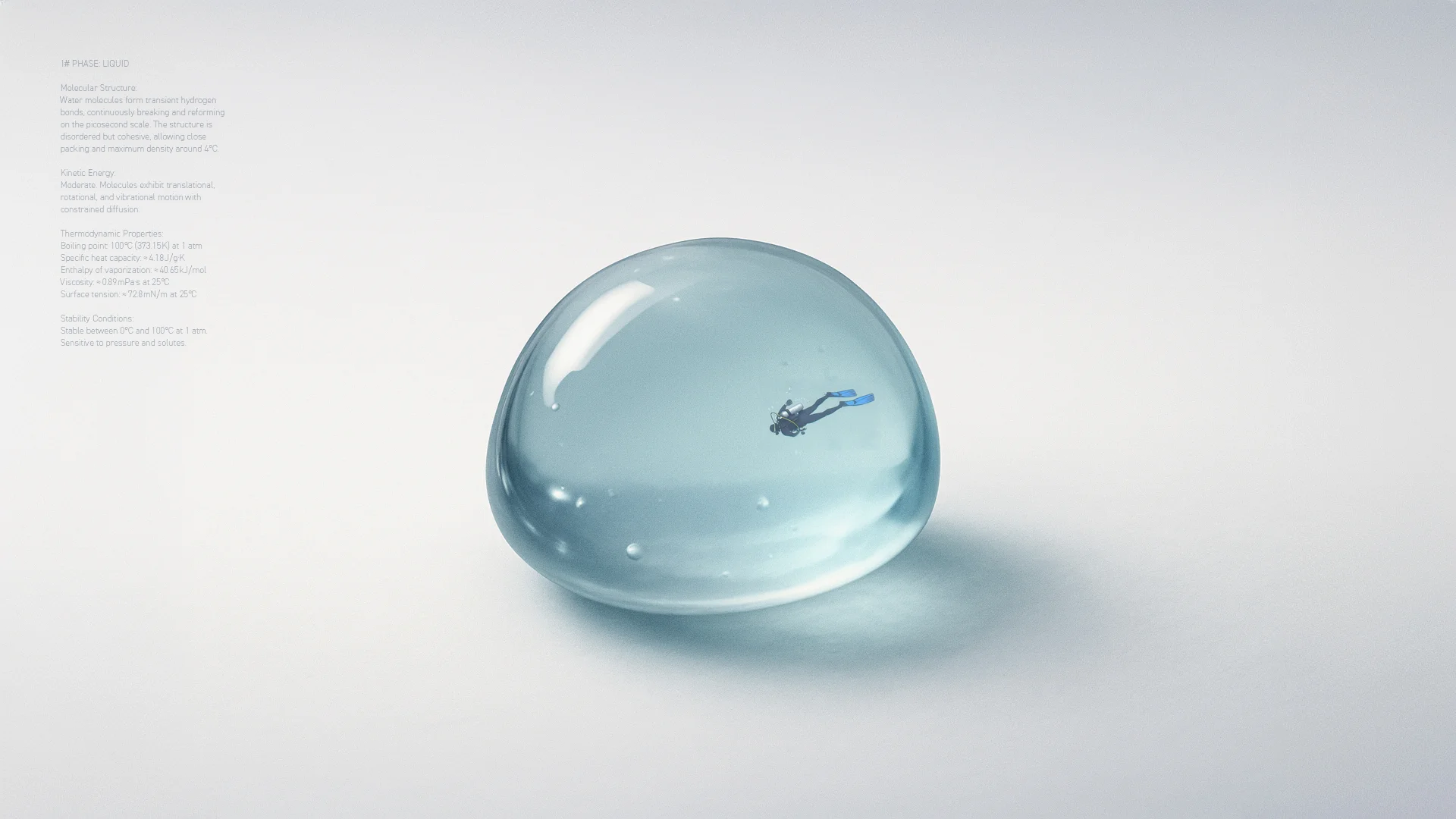
Adriel even gave it a name: Aqua Design, a UI approach based on the states of water. Its elements can solidify, evaporate, or flow again depending on the context and what the user is trying to do, so the UI behaves like matter, changes of state included.
The idea is a UI with symbolic physical behavior, where each state stands for an intention: solid for what’s permanent, liquid for what adapts, and vapor for what’s fleeting.
Second state: gaseous
Some elements could leave the way vapor does, instead of with the usual animation. A notification you have already seen or ignored could evaporate in front of you and leave a trail of moisture, or a little condensation somewhere else on the screen. That would mark time passing, and what changes if you leave it alone. The change of state can also carry urgency, when the thing should not linger, and it can mark what is ephemeral.
A feature could show up only under certain conditions and dissipate once it no longer matters, like steam on a window or breath on a cold morning. Those are the pieces that sit between being there and being gone. They can suggest something and then disappear on purpose, and they leave a trail, a sensation, or a clue.
Third state: solid
Ice is the other end: permanence, structure, and a place to focus. A component could turn solid when it must not change, when it needs attention, or when it has to be handled with care. A frozen button could mark confirming a transaction, sending a message you can’t take back, or pausing a critical process. You might feel that, as well as see it: a slight vibration, some tactile resistance, a crisp sound, or a symbolic temperature if the hardware ever allows it.
That solidity could melt with time or with use. A rigid menu could melt back into liquid if nobody touches it, and a firm decision could loosen. In a collaborative interface, an idea or a comment could stay «frozen» until another person unlocks it. An app could “freeze” its state to save a temporary version, the way you put something on ice.
Aqua Design takes its states from water. Flat Design matched the machines of its time. Faster processing is what makes this kind of change possible now.
Temperature and the other senses
Until now I have thought of interfaces as things we see and touch: screens that respond, buttons that activate, components that slide or disappear. Freezing and evaporating are older than that. Our species learned millions of years ago what they feel like, and that knowledge is still in our DNA.
Aqua Design asks a component to freeze, evaporate, or flow, and to react to its context, its environment, or its purpose.
The harder versions need hardware. An interface could respond to the ambient temperature and give temperature back on the surface you are touching. It could change with humidity, with light, or with how close you are. It could adapt to the person’s emotional state as well as to the screen’s resolution.
The cycles and the transitions matter past a pixel-perfect finish. A lot of this still sounds like science fiction. Better sensors, contextual intelligence, and faster hardware and internet are already blurring software and the room it sits in. Virtual reality is one way that is happening. The UI I want changes with its context and its meaning, draws on knowledge our species has gathered over thousands of years, and sits next to the interfaces we already have.
Back to the chat
After the keynote, the useful versions showed up in a chat with Adriel, a voice message, or a piece of news that reminded me of something I had already felt. Luckily, that is what our conversations are like: they move between what exists and what could.
Those interactions are virtual, and they can still change how we feel, how we move, and how we look at the technology around us. They are also a way of picturing how we might live with these devices.
A design system whose components freeze or evaporate can sound like a poetic exercise. A lot of trends start as a picture of something that seems far off and then, slowly, show up. I want to design with states of matter and try what still seems impossible, because that is often where the next trend in design systems comes from. I care more about imagining the interaction than about arriving before the hardware does.
Sources
- Apple’s Liquid Glass theme (The Verge)
- Material Design 3
- Flat Design (Interaction Design Foundation)
Thanks
This article came out of a conversation between friends, and from a hunch we share: design can keep learning from nature.
Thanks to Adriel Zárate for always being the spark that gets us imagining the future. And to you, on the other side, thanks for letting me share these ideas.
If this resonated with you or raised new questions, write to us, argue with us, add your view, or tell us what you have been imagining.