AI marketing platform
Opportunity discovery, content creation, and transcreation in one AI product for global brands and agencies.
- Brand
- Marketfully
- Deliverable
- AI platform
- Role
- Product Design Manager
- Industry
- Marketing / SaaS
- Year
- -
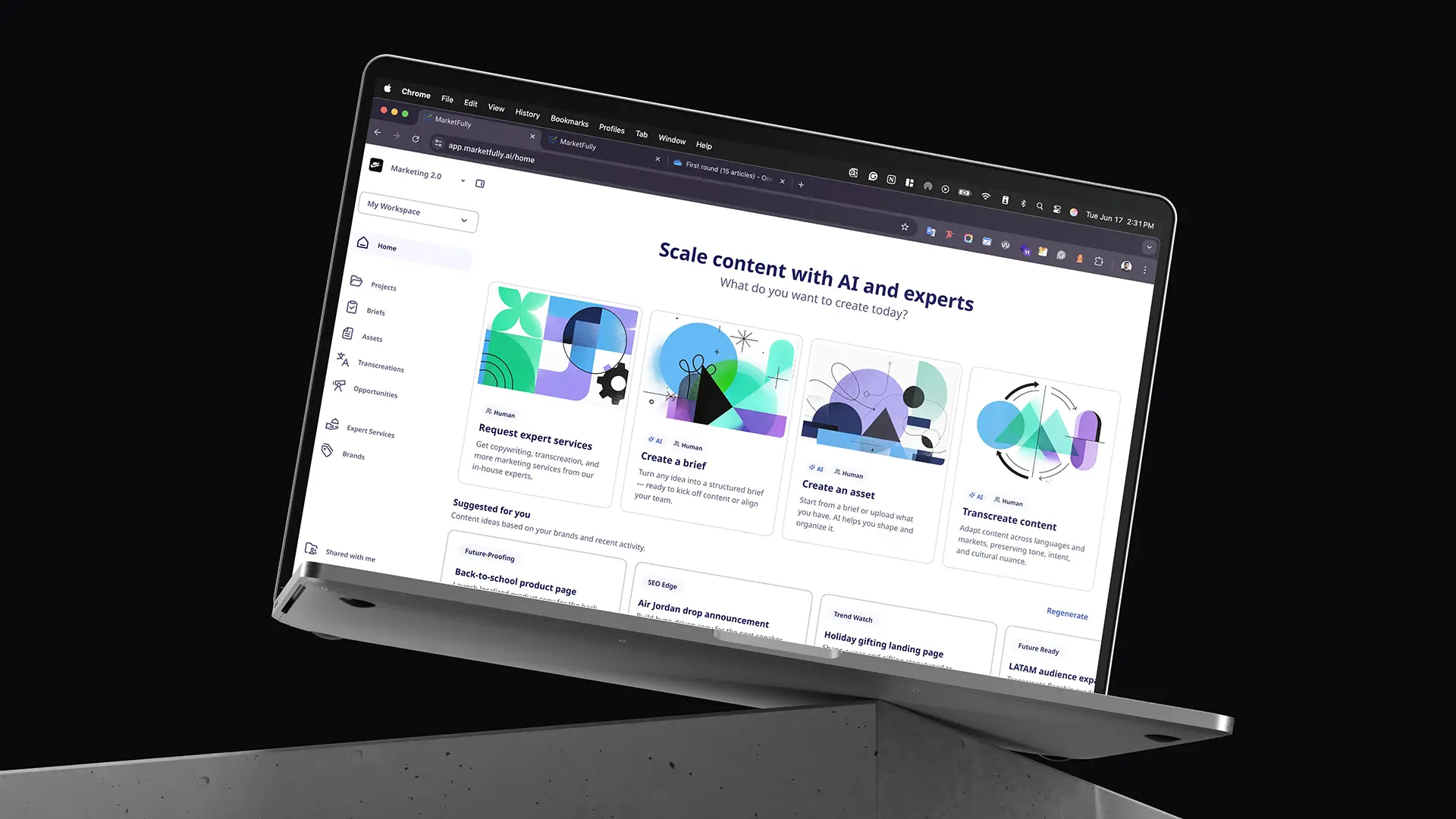
How does a team create on-brand content for global audiences?
After the acquisition of GetGloby, I led product design at Marketfully: a web app for marketing teams that create content for global audiences. One product to translate, transcreate, and generate content, with AI in the workflow and native-language experts available for human review.
The research
The concepts
The platform
Problem: slow turnaround, inconsistency, and AI used the wrong way.
Working across tools and channels added complexity. Every handoff lost context, so the brand sounded different in each language and errors piled up. Generic AI tools produced drafts quickly, and without confidence: they wrote from a blank page, with no brand, no audience, and no brief to hold them. Fixing that became repetitive work, and the same team still shipped inconsistent content.
Opportunity: one platform, from the idea to the value proposition.
If the brand lived in the product, and every brief was shared with the AI workflows and with the people doing the work, one team could go from an idea to a finished asset in every market without losing the thread. They could also request professional services from inside the platform. AI could flag likely problems, draft, and translate. People decided, and native-language experts stepped in when the risk or the budget called for it.
Shared context
AI first draft
Human in the lead
What we expected from AI, and what we found
The starting expectation, from the people leading marketing teams and from our own team, was full automation: a platform that would take a brand and produce every asset for every market, with no one in between. We spent the first months testing that hypothesis. We mapped the problems marketing teams actually had, ran the models against real briefs, and studied cases where generated content had already published.
Continuous discovery: research as part of the product
For the first three months, research was part of the daily work. We ran two or three interviews or feedback sessions each working day. The estimated volume is about 160 sessions.
Research kept going after design started. Each conversation was a chance to test a hypothesis, name a problem, or prioritize an opportunity, and then iterate. That is how we set the expectation of automation against the real work of marketing teams: where AI helped, and where a person still had to stay in the process.
What changed the product was seeing that fast generation didn't make content relevant, on brand, or right for its audience. We stopped aiming for full automation and designed a collaboration between AI and people.
The sessions kept pointing the same way. Automation saved hours on most steps, and many of them already ran on their own. But when a piece reached a market without a person guiding production and reviewing each stage, it was sometimes off tone, off brand, or irrelevant to the reader. The people in the process were what made the content worth publishing.
The research also helped us define our users. Three people sat in every purchase: the champion, who brought the product in; the economic buyer, who paid for it; and the operational gatekeeper, who had to work in it every day. We documented each one, including buying signals and the tech stack they used.
From findings to decisions
Continuous research let us drop decisions that had looked obvious at the start and prioritize what teams needed: control over the result, a consistent brand, collaboration, and adaptation for each market. That set the architecture, the flows, and the order of the roadmap.
Concepts: the platform and its architecture
The v2 architecture I developed set the hierarchy as organization, workspace, brands, and content. The knowledge base (brand, voice and tone, glossaries, audience personas, style guides) was built into every workspace. That structure flexed across the use cases we had already identified.
The flow branches into opportunities and improvements, brief development, content generation, and transcreation for different audiences.
The system underneath has a few core layers: an API and MCP layer, an agent harness with tools, skills, and subagents, and a brand brain.
Concepts
Flows and wireframes
Concept map
What we designed, in numbers. The first three are approximate working counts.
A design system, and a team to build it
I developed the design system the product was built on. It started from a color palette, then semantic tokens for text, icons, surfaces, and borders, named by role rather than by color, and those tokens became components. Components were applied across templates, consistent on every screen and intuitive to use, so a critical border or a muted label meant the same thing everywhere. The goal was an interface that stayed quiet and out of the way, close to invisible. The brands and their content had to be the loudest thing on the platform.
Designing so it could scale
Semantic tokens, reusable components, and shared patterns also had to support new features and give more than one team the same product language. It carried the platform from generation and localization through collaboration, administration, and expert services.
I also stood up and led the product design team: a Product Designer, an AI Solution Designer, and a UX Researcher, reporting to me. Together we owned how the product looked, how it behaved, and how we learned from the people using it.
Leadership across disciplines
As Product Design Manager I connected what users needed, what the business wanted, and what the technology allowed, and turned that into a product direction.
Three specialists in design, research, and AI solutions reported to me. With product management, engineering, operations, and the business, we set priorities and the roadmap, and coordinated architecture and implementation. Continuous research put user feedback into those conversations, and kept discovery, design, and development in the same line.
What shipped: a workspace that holds the team and the brand
Organizations held workspaces and teams. Admins created teams, assigned each member a role such as account manager or member, and decided which teams and users could access each workspace. One company could run marketing, sales, and HR in parallel without splitting the brand across tools.
Workspace and brand
Organizations
Teams and roles
Brand
The brand lived in the product, not in a PDF. Every asset was part of the knowledge base behind each generation, and nothing entered it unchecked: an audience the AI proposed stayed suggested until someone iterated on it and approved it. Content for Argentina and content for the United States came from the same sources, under the same brief, adapted for different audiences, and checked for a possible negative effect through an AI review.
From an opportunity to assets for every market
The value proposition came down to four pillars:
- Expert services: fully human workflows.
- Creation and transcreation: briefs and assets, with AI and people working on the same piece.
- Proactive suggestions: content ideas drawn from the brand's recent activity.
- Opportunities: a system that ranked ideas by score, type, cost, market, and effort.
Every row in Opportunities ended in the same action: start a brief. The brief held the goal, audience, language and location, tone, and an outline per asset template. The assistant filled it in with the team, checked it for inconsistencies, and scored how complete it was before anything was generated. The draft then opened in the editor, beside the brief, its keywords, and a risk score.
Core flows
Find an opportunity
Shape the brief
Edit beside the brief
Generation was a starting draft. The team iterated it in place, together: improving, shortening, checking keywords, adjusting the tone, or rewriting, without leaving the document. When the piece needed a native eye, they requested expert services: content review, accuracy verification, translation, or an SEO check, each tracked by cost and status. Once approved, the asset could be transcreated for other audiences, so a campaign could reach each market without being rewritten from scratch in every language, when that was the right path.
Review and scale
Iterate with the assistant
Hand it to an expert
What the work produced
The work moved from exploring what AI could automate to a platform that holds creation, editing, localization, and review in one place. Discovery was the first three months, an estimated 160 research and feedback sessions, and full automation stopped being the goal. What we built is a collaboration between AI and professionals: one architecture for organizations, workspaces, brands, audiences, and content, and flows for opportunities, briefs, generation, editing, and transcreation. The design system is reusable, so the platform can grow without drifting. Design and research worked with product, engineering, and the business to turn what we learned into solutions.
Shipped
From the sessions
Direction
What we agreed to change
We dropped the first hypothesis and built a tool marketing teams could run. Full automation was easy to sell, and in practice it was an illusion. The agent drafts and reviews from brand data and from context outside the brand. The team reviews each change, with AI still in the process, and the asset goes out after that review. An asset that drifted from its brief had failed, even if an expert could have fixed it later.
What I learned
Someone still approves
The brand, written once
The brief stays attached
Research during the build